
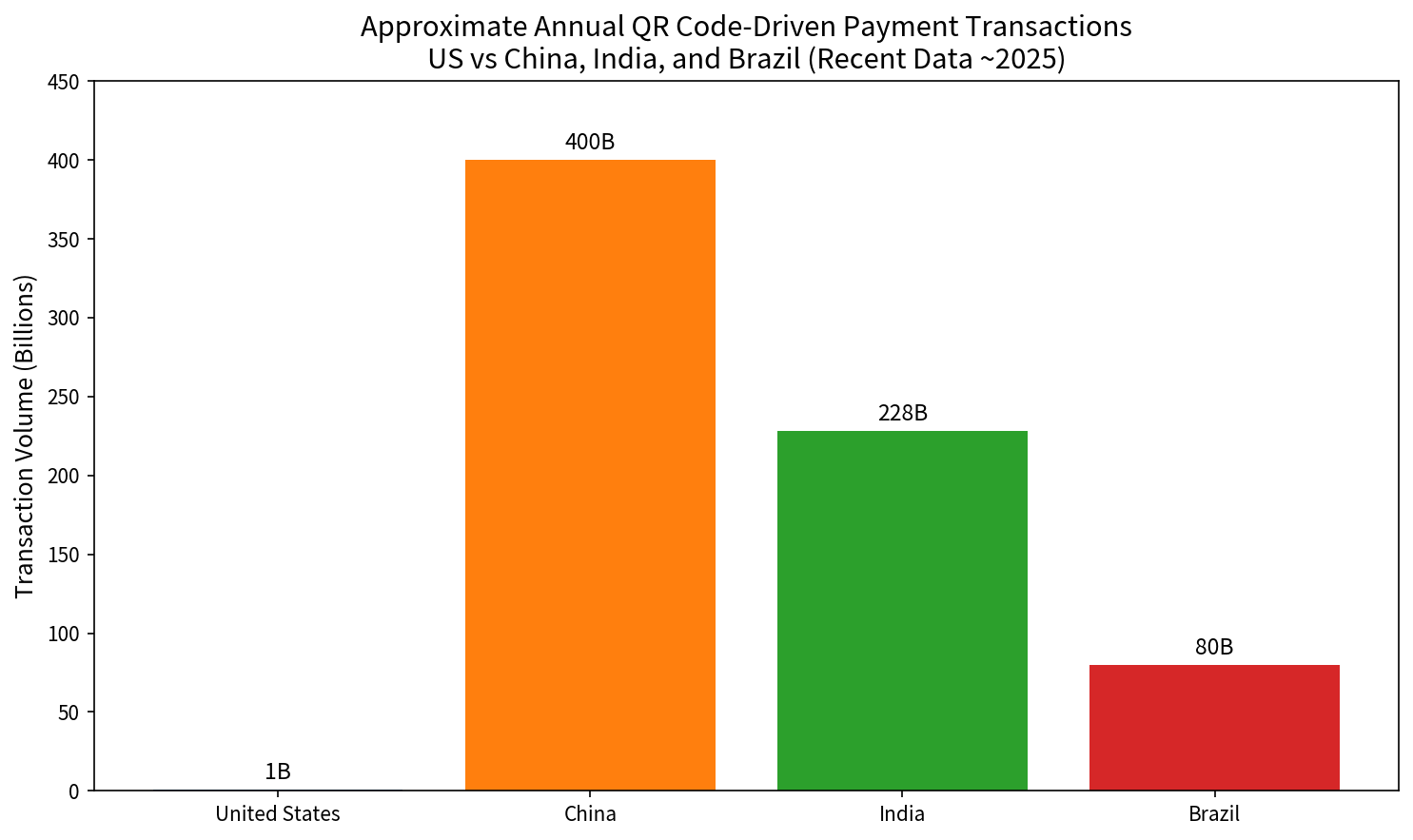
**please recall the above is for the whole country and one year. In particular China number is different, larger, than the the text, several reasons: First is graph above include WeChat, not just Alipay. Second, WeChat is like venmo, lots of small P2P transactions vs Alipay more retail oriented. The remainder is close enough.
On July 14, 2026, the Accredited Standards Committee X9 Inc. (X9) announced a new QR code payment standard intended to accelerate instant payments in the United States. The announcement formally published the new American National Standard X9.150, Merchant-Presented QR Codes for Secure Payment.
We are taking it from the top; Let us explain.
X9 is the ANSI-accredited nonprofit organization responsible for developing and maintaining U.S. financial industry standards and serving as the U.S. Technical Advisory Group for ISO TC68 on financial services. The American National Standards Institute (ANSI; www.ansi.org ) is a private, non-profit organization that administers the U.S. voluntary standards and conformity assessment system. ANSI oversees the development and use of voluntary consensus standards across every industry in the United States. Importantly: ANSI itself does not write or develop standards; It accredits independent Standards Developing Organizations (SDOs), such as the Accredited Standards Committee X9 (the group behind the recent X9.150 QR-code payment standard) and approves their work as official American National Standards (ANS) only after they meet strict due-process, openness, and consensus requirements.
What are the implications of the X.150 QR-code for payments?
These rules enable interoperable initiation and processing of QR-code-based payments across multiple networks and service providers. A core design feature is that a single merchant-presented QR code can trigger payments over different rails like FedNow, RTP (The Clearing House’s Real-Time Payments network), ACH credit transfers, or emerging methods such as stablecoins. Financial institutions and payment providers retain the flexibility to choose the most suitable rail for each transaction rather than forcing merchants to support separate flows for every network. Security is emphasized throughout. Unlike ordinary URL QR codes (used for static content such as menus), payment QR codes under X9.150 must be scanned from within a logged-in, authenticated mobile application that is itself recognized as an authorized client. The payment information is digitally signed using public-key cryptography supported by the X9 Financial PKI (managed in conjunction with DigiCert). The release notes that this infrastructure is also helping prepare the industry for post-quantum cryptography signatures.
How does X.150 work?
The answer is best described by example: A biller or merchant displays a (dynamically generated) QR code. The customer scans it with the camera of an authenticated banking or digital-wallet app. The app retrieves a protected payment payload, the customer authorizes the transaction, and the payment is completed instantly as a push (account-to-account) transfer. No card numbers, bank account details, or other sensitive financial information are exchanged between the parties. This approach is positioned as more secure and convenient than cash, checks, or traditional card payments.
Where are similar systems in use and what are their transaction volumes?
India processes twenty billion instant payments per month and Brazil about eight billion, while the United States manages only about forty-five million. A primary reason for the U.S. lag is the absence of a national standard for secured, merchant-generated payment QR codes. Without interoperability, banks, merchants, and payment networks operated in a fragmented environment that hindered large-scale rollout. X9.150 directly addresses that gap. It defines: The structure and content of the QR code itself; The payment-payload data model; Message structures and security requirements and Payment-notification mechanisms.
Wasn’t Alipay the first with the most in QR payments?
Yes, by a long shot. On January 5, 2025, we wrote:
“Alipay is the leading digital payment platform in China, known for standardizing the use of QR codes at merchants and mobile payments by consumers. Let us explain.
Hard to imagine, but a generation ago China was largely a cash-based society. All at once, an edict from the top assigned consumers a bank account, a debit card and required businesses to pay their employees electronically. Chaos ensued. Citizens didn’t believe they had actually been paid because they couldn’t see and hold the money. Further, no one knew what a debit card was, there were not enough ATMs to service the sudden crush of demand, and those mechanisms (made by western manufacturers) would either break down or run out of cash so frequently that the underdeveloped support infrastructure couldn’t keep up. It literally became a 24/7 problem in metropolitan areas). What’s more, adoption was extremely slow for merchants. Small and medium sized retailers were in no rush to install point-of-sale (PoS) equipment due to lack of familiarity, counter space and incremental cost.
Enter Jack Ma, Co-Founder of Alibaba Group – Better to ask for forgiveness than permission.
AliPay was originally designed as a payment platform to enable the purchase of e-commerce goods and services for Alibaba (a very large Chinese e-commerce company). AliPay extended its payment services to the physical world with small and medium sized retailers by leveraging the consumer’s mobile phone, and similarly the merchant’s mobile phone or tablet. This cheap, easily accessible, all-inclusive approach to service the hard-to-reach and greenfield (cash based) SMB marketplace jump-started the adoption of electronic payments in China. AliPay bypassed China Union Pay (CUP; the government’s nationwide payment system), and didn’t need a debit card or PoS device to do it. All one needed was an AliPay account. Adoption was so explosive, and generated so much volume in such a short period of time, CUP’s domestic TAM was greatly reduced.
AliPay is accepted at 90% of China’s retailers in medium and large cities, 50% overall share in the country (WePay is its biggest competitor, primarily in rural areas). Over 700 million consumers and 70 million retailers utilize AliPay in China which generates an astonishing gross payment volume (GPV) of over $10 trillion from 50 billion transactions per year (for comparison these are Visa type numbers). Also noteworthy, its merchant discount rate (MDR; the cost to the retailer to accept electronic payments) is well under 1%. This is in contrast to the US where the SMB is charged the highest MDR of any merchant class, frequently 2.5% to 3.5%, sometimes more. The brainchild of its founder, Jack Ma, today AliPay operates as a unit of Ant Group, which is one third owned by Alibaba and a series of Chinese based institutional investors. We view AliPay as a remarkable success story which we think is worthy of discussion.”
Conclusion
By creating a shared, cryptographically protected format that works across FedNow, RTP, ACH, and other account-to-account rails, X9.150 removes a key technical obstacle to interoperability. Industry participants expect the standard to accelerate U.S. instant-payment adoption, moving the country closer to transaction volumes seen in markets such as India and Brazil while improving security, convenience, and operational flexibility for merchants, banks, and consumers. Once adopted, standardized domestic QR codes could give retailers and consumers more payment options. If so, traditional payment cards may lose some of their hold at the retail point of sale, potentially leading to lower merchant discount rates.