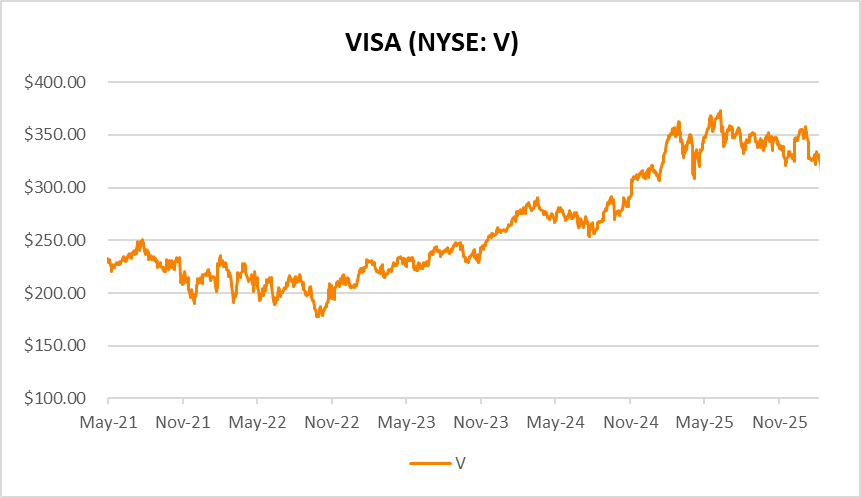
We are taking another look at Visa (NYSE: V) following its impressive 2Q2026 earnings report and the stock’s 10% uptick. Through April 28th, Visa shares had trailed the S&P 500, having risen only about 3% since early 2025, while the S&P climbed 21%. Investor concerns included possible new regulations, ongoing litigation, rising incentive costs, worries about weakening consumer spending, less attractive economics due to stablecoins, and Europe considering a competing payment network. Not everything is as it seems.
Let us explain.
Visa achieved its strongest organic growth in a decade, excluding pandemic recovery and acquisitions. For Q2 ending March 31, net revenue rose 17% to $11.2 billion, with EPS up 20%. Payment volume increased 9% to $3.7 trillion and transactions grew 9% to 66 billion.
What are the operational highlights everyone is so excited about?
- Double play: Beat 2Q consensus and raised full year guidance.
- Quality results across the board exceeded 2Q26 consensus revenue, Adjusted EBIT and Adjusted EPS by 6-8%
- US and Europe posted strong consumer and business spending, suggesting economic resiliency despite widespread concerns. Good news for 55% of revenue by geography.
- CEMEA was down 250 bpts due to US/Iran conflict. Not as bad as feared and 6% of revenue. So, light at end of the tunnel if and when conflict ends.
- Value added services (VAS) now represents 30% of revenue (by service line) and is growing at a brisk 25% rate. VAS are a fast-growing, high-margin part of the business beyond traditional transaction processing (interchange fees). They represent non-payment network revenue that Visa sells to banks, merchants, fintechs, and governments. These services include Fraud & Risk Management, Data Processing & Issuer/Acquirer Solutions, Acceptance & Merchant Solutions, Consulting, Analytics & Advisory, Digital & Open Banking / Money Movement, Cybersecurity, Dispute Management, loyalty, and Identity Solutions. Strong demand and favorable pricing led to VAS discussion on earnings call.
- The high margin cross border transactions were up 11% consistent with prior quarter. Cross border ecommerce demonstrated slight Q/Q improvement to 13%. Investors may recall the profit margin on FX is 95%+.
- Client incentives (contra revenue) are down.
- The board authorized a new $20 billion multi-year repurchase program (remaining capacity ~$33 billion after Q2). If all $33 billion exercised at the closing price of $309.33
on April 28th implies the company can repurchase 106.8 million shares or 5.6% of the 1.88 billion shares outstanding.
What about non-operational items?
During the 2Q26 Visa repurchased $7.9 billion of Class A common stock (~25 million shares at an average price of $320.66). Mathematically, if the share buyback were completed on the first day of quarter would have helped EPS by 1%. Not material to 2Q26 results.
Visa also paid out $1.3 billion in dividends (recurring and a good thing) during the quarter, bringing total shareholder returns of $9.2 billion (including share buyback) for that period.
However, if we understand correctly, the $33 billion in remaining authorization is included in the raised FY26 adjusted EPS guidance. This implies $0.73 contribution to the new $12.95 adjusted EPS consensus, but that impact could be less if those share repurchases are spread throughout the remaining quarters.
Outlook and Risks
Visa now expects low double-digit to low-teens net revenue growth and low-teens adjusted EPS growth for FY2026. Potential headwinds remain sustained high energy prices (gas now $4.35/gallon vs. ~$3.20 last year), which could pressure consumers, and geopolitical uncertainty. However, higher gas prices may actually benefit Visa in the near term, as credit cards (average U.S. ticket ~$80) capture more of these larger purchases than debit cards ($45). We are mindful of the economic trickledown effect of higher energy prices on the economy as a whole and ask what is the sustainability of the US consumer if those upward pricing pressures persist?
Summary
The company’s strategic investments in its technology infrastructure and service offerings are yielding positive results. It is well positioned to capitalize on the increasing adoption of stablecoins, which are now generating transaction volumes close to a 7-billion-year end run rate.
Annually, Visa is set to enable three hundred billion global transactions worth more than $13 trillion. What is more, the company serves 175 million locations, five billion credentialed users through 14,500 financial institutions in two hundred countries worldwide. As always, interested parties should review the company’s SEC filings, web site, investor presentations, and the earnings conference call transcripts.
